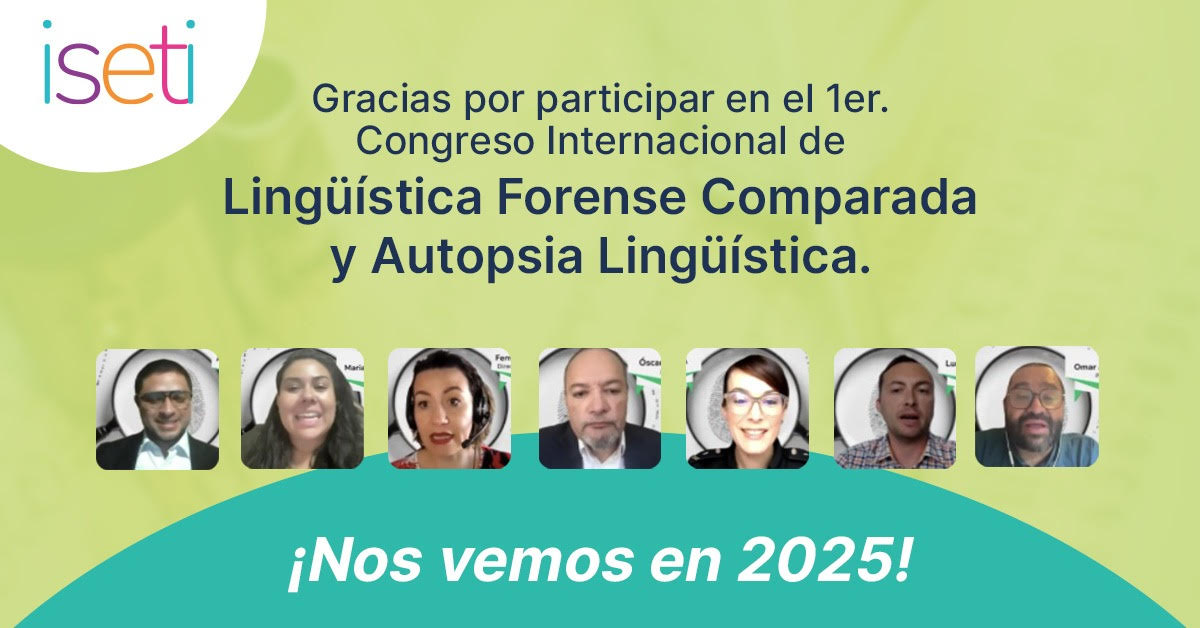
Pioneering event that brought together experts and enthusiasts of comparative forensic linguistics
On June 4-5, 2024, the Higher Institute of Studies in Translation and Interpretation of Mexico City (ISETI) and its graduates from the first generation of the Diploma in Comparative Forensic Linguistics successfully organized the First International Conference of Comparative Forensic Linguistics and Linguistic Autopsy. The event, held online, brought together five hundred and fifty live and asynchronous attendees: students and professors of the global linguistics community, as well as from other areas of knowledge and scientific-academic work, such as philology and history, translation and interpretation, law, criminology, criminalistics, and forensic psychology; journalism and communication; international and business relations, among many others; offering a platform for knowledge sharing and exploration of the latest trends in this emerging field.
An enriching program with renowned speakers
The conference had an exhaustive program that covered a wide range of topics related to comparative forensic linguistics, from theory and methodology to practical applications in various fields. Featured speakers included:
- Professor Oscar Alvarez (USA): Creator of the analytical approach of Comparative Forensic Linguistics and Linguistic Autopsy, global director of the Comparative Forensic Linguistics Project (Berkeley, CA) and professor of Diploma in Comparative Forensic Linguistics organized by ISETI. Professor Alvarez offered two presentations, giving participants a deep perspective on the methodological principles of the discipline and its anticrime techniques: linguistic autopsy and anatomy of deception.
- Alicia Juarez Bielsa (Spain): Expert analyst and member of the Behavior Analysis Section of the Central Criminal Intelligence Unit of the Spanish National Police. Juarez Bielsa gave a keynote lecture on the practical application of linguistic autopsy at this first conference, highlighting its relevance in criminal investigations.
Representing the graduates of the Diploma in Comparative Forensic Linguistics, they distinguished themselves with their participation:
- Professor Ludovic Masson (Belgium): Linguist specializing in terminology and translation and a pedagogue by training. Speaks five languages: French, English, Dutch, Catalan, and Spanish. Researcher professor at the Pompeu Fabra University of Barcelona, with notable multicultural training. Director of the Comparative Forensic Linguistics Project in Europe. Professor Masson contributed his vision on the institutionalization of comparative forensic linguistics, which mainly involves terminological standardization and continuous training of experts, in addition to constant development of the theoretical and applied aspects of the discipline.
- Professor Alejandro Correa (Monterrey, Mexico): Multidisciplinary professional with a solid background that includes training in chemistry, materials science, education, advertising, data science, and comparative forensic linguistics. A speaker of Spanish, English, French, German, and Italian, he stands out for his ability to adapt to different cultural, educational, and technological contexts, as well as his passion for implementing continuous improvement, research, and innovation projects in all the areas in which he works. Professor Correa’s presentation focused on the alarming current crisis of academic integrity and how he has proposed to confront it through a structured investigative interview proposal that is characterized by its reflective-formative approach with empathy towards his students, as well as his first findings and experiences when applying this methodology in their teaching practice.
- Omar Delgado (Mexico City): Writer, journalist, educator, and expert for the judicial branch of the federation in Mexico. Candidate for a Social Sciences and Humanities doctorate from the Metropolitan Autonomous University in Cuajimalpa. Director of the Comparative Forensic Linguistics Project in Mexico. In his presentation, Delgado proposed the development of a forensic linguistics battery through autofiction writing. Its objective is to develop a tool of truthfulness and reliability based on the tools of creative writing and the principles of forensic linguistics (Statement Analysis).
The event was chaired by ISETI’s hosts, Fernanda Salazar (academic director) and Mariana Santiago (instructor).
The speakers’ investigations covered two axes:
1. Comparative Forensic Linguistics: Methodology, practice, and institutionality.


2. Towards a better understanding of society: the new contributions of Comparative Forensic Linguistics in our daily lives.


Diverse and exciting topics
The conference addressed a wide range of topics relevant to comparative forensic linguistics, including:
- Theoretical-methodological principles of comparative forensic linguistics and linguistic autopsy
- Terminological normalization of the discipline
- Operational application of linguistic autopsy
- Anatomy of deception
- The integrity of education in high school youth
- Discovery of the logical-mathematical “footprint”
- Proposal of the literary resource of autobiography to detect signs of integrity
A resounding success that sets a precedent
The First International Conference of Comparative Forensic Linguistics and Linguistic Autopsy was a tremendous success. It brought together experts, students, and enthusiasts from over 170 universities and other academic and police institutions, including UCLA, Sorbonne de Paris IV, the French Alliance, Berlitz, UNAM, Tecnológico de Monterrey, the Universities of Cordoba and Seville in Spain, University of Montreal, Sophia University, University of Costa Rica, National Police of Peru, and many more from a total of 25 countries including Canada, Argentina, the United Kingdom, Spain, Luxembourg, Australia, Indonesia, and Ivory Coast. The event provided an invaluable platform for exchanging knowledge, discussing ideas, and exploring new applications of comparative forensic linguistics.
The Conference also set an important precedent by bringing together graduates of the ISETI Diploma in Comparative Forensic Linguistics, who have enthusiastically begun their foray into the world of research and analysis immediately upon graduating from the diploma, joining Professor Álvarez’s team of linguists, developing their experience in the discipline and contributing to its advancement. The active participation of these professionals reflects ISETI’s commitment to training experts in comparative forensic linguistics and its role in promoting this discipline in Mexico and internationally.
In conclusion, the First International Conference of Comparative Forensic Linguistics and Linguistic Autopsy was a pioneering event that brought together experts and enthusiasts of the discipline, promoting knowledge exchange and laying the foundations for the future of comparative forensic linguistics in Mexico and the world
 Comparative Forensic Linguistics