
Forensic Linguistics, Comparative Forensic Linguistics, and Linguistic Autopsy
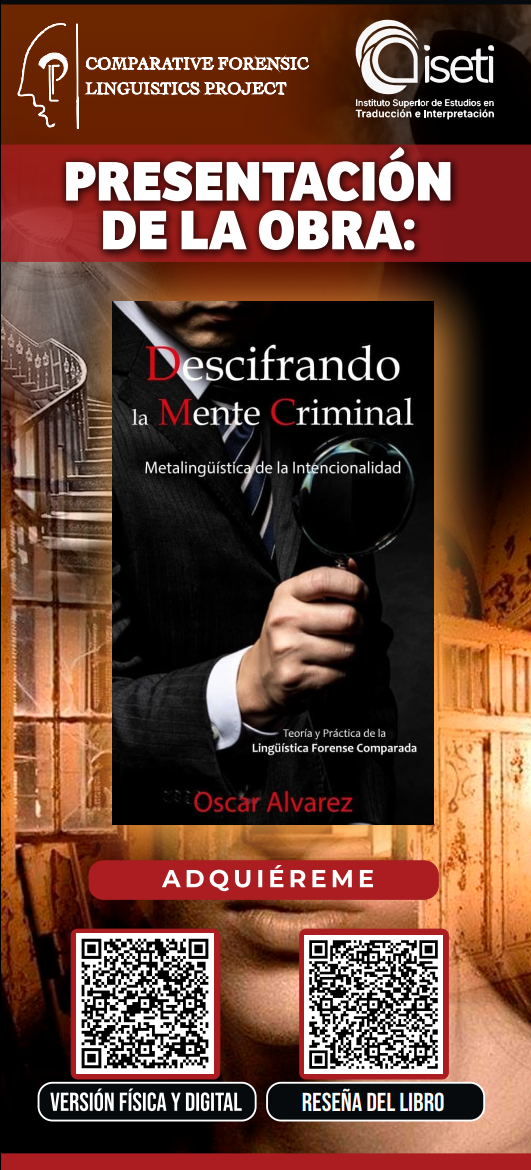
This is Óscar Alvarez‘s first ebook
By Oscar Alvarez
Last updated: Aug. 28, 2025
The Comparative Forensic Linguistics Project is an independent research project that combines scientific, academic, and operational expertise. It is made up of an elite international team of professionals, including:
- Linguists
- Psychologists
- Medical doctors
- Criminal behavior and intelligence analysts
- Criminologists
- Lawyers
- Translators and interpreters
All team members are committed to upholding the principles of science and justice. They are drawn from prestigious global academic, police, and intelligence institutions. These experts serve as guest professors for the annual Diploma in Comparative Forensic Linguistics and present papers at the International Conference of Comparative Forensic Linguistics & Linguistic Autopsy at our academic home, the far-reaching institution: Higher Institute of Translation and Interpretation Studies (ISETI), in Mexico.
Updated: July 4, 2025
Comparative Forensic Linguistics Project Welcomes New Leadership
I am pleased to announce the addition of two esteemed colleagues to the Comparative Forensic Linguistics Project team.
Dr. Juan Carlos Angeles Ando will be the new director of the Department of Studies in Neuropsychobiology, Language, and Criminal Behavior.
Lic. Norberto Ávalos Rodríguez will lead the Department of Transdisciplinary Forensic Studies of Sign Languages and Deaf Communities.
The continuous development and dynamic nature of our discipline requires regular theoretical and methodological updates. The integration of Dr. Angeles Ando and Lic. Ávalos Rodríguez, along with their respective departments, formalizes these scientific approaches within our official analytical framework. We have been actively exploring these two fiels for several years.
Refining the Definition of Comparative Forensic Linguistics (CFL)
While our previous definitions of Comparative Forensic Linguistics remain valid, this expansion necessitates an adjustment to its official description.
Comparative Forensic Linguistics (CFL) is the forensic science of intentionality. It employs a linguistic, cognitive, neuroscientific, evolutionary, and biopsychosocial approach to study verbal behavior—whether oral, written, or signed—within interlinguistic and intercultural contexts. Its primary objective is to uncover explicit, implicit, or hidden intentionality within linguistic evidence.
updated: July 27 & 29,2024
Forensic Linguistics
Forensic linguistics is a specialized field that applies linguistic knowledge to legal matters. Focusing primarily on language as evidence, it analyzes written or spoken texts to determine authorship, authenticity, or the meaning of specific utterances. Its primary objective is to provide linguistic expertise in support of legal proceedings.
Comparative Forensic Linguistics (CFL)
Comparative Forensic Linguistics (CFL) is a dynamic and interdisciplinary field that integrates knowledge from linguistics, behavioral sciences, anthropology, and other disciplines to examine language within its social and cultural context. CFL views language as a complex interplay of cognitive, emotional, and behavioral factors rather than a static artifact. CFL constructs detailed profiles of individuals and their communicative behaviors by analyzing linguistic patterns, stylistic choices, and emotional cues. This holistic approach enables CFL to provide valuable insights in legal investigations and other areas where understanding human communication is crucial.
Similarities and Differences Between Forensic Linguistics and Comparative Forensic Linguistics
Forensic and comparative forensic linguistics share common ground in analyzing language within legal contexts but diverge significantly in their scope, methodologies, and objectives. Forensic linguistics operates primarily within the confines of linguistic analysis. Its primary function is to examine language as tangible evidence. By analyzing written or spoken texts, forensic linguists seek to establish facts such as authorship, authenticity, or the precise meaning of statements. Their expertise is invaluable in supporting legal proceedings by providing objective linguistic analysis. Comparative forensic linguistics (CFL), on the other hand, takes a broader and more interdisciplinary approach. It positions language as a complex interplay of cognitive, emotional, and social factors. CFL integrates knowledge from linguistics, behavioral sciences, law enforcement, intelligence, sociology, and other relevant disciplines to comprehensively understand the individual behind the language. Instead of merely analyzing linguistic features, CFL delves into psychological and behavioral dimensions of language use. This holistic perspective enables CFL to contribute to a broader range of investigations, including those requiring linguistic-behavioral profiling and/or the analysis of extremist discourse.
In summary, while both fields share common ground in the legal application of language, forensic linguistics focuses on the linguistic artifact itself. In contrast, comparative forensic linguistics seeks to understand the individual and their communicative context. The former is primarily concerned with establishing facts, while the latter aims to develop a deeper understanding of the human factors that influence language use.
Linguistic Autopsy (LA)
LA was born as a simple tool that evolved into a technique. It has now taken flight on its own, establishing its principles and methodological approach while maintaining the fundamental support of the techniques that make up Comparative Forensic Linguistics or its dynamic, multidisciplinary, and multicultural perspective. Thus, we could redefine it as an “anti-crime analytical-methodological approach.” Its practical application can assist investigators-analysts in creating hypotheses and lines of inquiry for complex, high-profile cases: homicides, serial killings, extortion, kidnappings, anonymous threats, organized crime, political corruption, and fraud.
The investigative, qualitative, quantitative, linguistic, anatomical, and behavioral analysis of linguistic autopsy allows us to measure, count, and predict the intention and levels of violence and danger of criminals and suspects.
The condensed definition of linguistic autopsy is reduced to the study of intentionality. However, to fully understand this concept, it is vital first to understand what metalinguistic awareness, metapragmatic awareness, and the philosophy of language approach to the analysis of intentionality mean, which are the scientific-methodological pillars of linguistic autopsy.
Simplified Explanation
The text describes linguistic autopsy as a specialized technique used to analyze language in legal investigations. It goes beyond simply looking at the words on a page; it delves into the more profound meaning and intent behind the language.
Key points:
- Evolution: It started as a simple tool but has developed into a complex methodology.
- Purpose: To assist in solving complex crimes by analyzing language.
- Scope: Used in various cases, from homicides to fraud.
- Method: Combines multiple disciplines (linguistics, psychology, etc.) to analyze language and predict criminal behavior.
- Focus: The core concept is intentionality. To understand intentionality, one must grasp metalinguistic and metapragmatic awareness and the philosophy of language.
In essence, linguistic autopsy is a forensic science of language, helping to uncover the truth behind words.
*Comparative Forensic Linguistics and its Supportive Techniques
In 2012, Professor Oscar Alvarez proposed the analytical approach of Comparative Forensic Linguistics in Berkeley, CA. Years later, he consolidated it with the creation of two fundamental tools for his theoretical-methodological apparatus:
The Technique of Linguistic Analysis of Verbal Behavior (LAVB) and
The Technique of Comparative Analysis of Base Structural Data (CABSD)
Both were developed in the Comparative Forensic Linguistics Project (CFLP), a project directed and founded by Alvarez and assisted by an international team of verbal behavior analysts. These techniques, with practical examples, are part of the Professional Training Certificate in Forensic Analysis of Verbal Behavior, taught online (2021-2022) by Alvarez and included in the CFLP manual entitled ‘Forensic Linguistics: Applications and Functions’’. The following are some highlights of the course:
- Theoretical-methodological and practical bases of the LAVB and the CABSD
- Cases analyzed with the LAVB and CABSD techniques by Alvarez
- A case studied with the CABSD by the linguist/anthropologist De la Cruz Bautista
- Example of an expert report made by the linguist/anthropologist, Neri Pérez
- Overview of Forensic Linguistics
- Examples of Forensic Linguistics cases analyzed by international experts
Comparative Forensic Linguistics is a comparative analytical approach, both at a theoretical-methodological and a practical level. Its goal is to find, in civil and criminal cases, the linguistic evidence (LE) hidden in oral or textual discourses through the Linguistic Analysis of Verbal Behavior (LAVB). LAVB is the systematized study of verbal behavior patterns. It can be applied to any linguistic material that is the product of one, two, or more languages. Interlinguistic and intercultural issues are part of its natural interest. It is comprised of the sum of three analytical filters:
- Sociocritical method (SC) from University Paul Valery, Montpellier, France by Edmond Cros
- Forensic Linguistics (LF), UK, the USA by John Olsson, Roger Shuy, and others
- Statement Analysis (SA), known initially as SCAN Technique, Israel, USA, from Sapir, McClish, FBI, and BATI
and two supporting techniques:
- The Linguistic Analysis Verbal Behavior (LAVB)
- The Comparative Analysis of Structural Data Base (CASDB)
which, by comparing and confirming the accuracy of their results and preventing bias, leads us to find the Linguistic Evidence (LE) using the following formula:
CFL = (SC+LF+SA) LAVB + CASDB —-> LE
*Alvarez, O. (2022), Course-Manual: “Forensic Linguistics: Applications and Functions,” School of Experts of the Attorney General of the State of Tabasco, Mexico, Comparative Forensic Linguistics Project.
Note by Oscar Alvarez
Comparative Forensic Linguistics is an analytical approach in constant evolution. The text below was published here on this site on April 8, 2014, two years after starting this critical analytical, investigative adventure. Although this discipline advances and evolves, the essence and the principles remain intact.
This blog is educational and for sharing ideas (not for debates). It’s an introductory course in Comparative Forensic Linguistics Analysis for bilingual (Spanish-English) professionals or readers interested in this topic. I will be publishing my posts mainly in Spanish, but many of my examples, articles, or recommended videos, will be in English. I might review cases and examples in other languages only if I find a specialist who can do the comparative analysis in Spanish or English. My posts will follow a specific academic and practical order and be published in the language they were written. Any reply or comment to this blog can be made in any of these two languages.
Comments and participation from linguists and readers interested in Forensic Linguistics or justice will be welcome, as well as the participation of specialists in such diverse areas as:
– Semiotics – Sociolinguistics – Discourse Analysis
– Psychology – Sociology – Social Work
– Law – Journalism – Police Investigations
Forensic Linguistics
Forensic linguistics is, in a few words, the application of linguistic methods in the legal context; the use of language as evidence in police investigations or court.
Some refer to forensic linguists as language detectives since their analysis of linguistic evidence may assist in investigations, and they can serve in court as expert witnesses. Let’s watch the following (4:24 minutes) video from Discovery Investigations, where Dr. Robert A. Leonard (Director of the Graduate Program of Forensic Linguistics at Hofstra University in Hempstead, New York) introduces us to this fascinating world through two cases solved by forensic linguistic analysis:
Below is a list of the main topics that will be covered in this blog:
Forensic Linguistics
Comparative Forensic Linguistics
Psycholinguistics
Forensic Statement Analysis
Discourse Analysis
Sociolinguistics
Forensic Linguistics top representatives and bibliography
Other related disciplines
Specialties of Forensic Linguistics:
– Statements Analysis: detecting lying and deception
– Author language profile: threatening letters & emails
– Ransom notes analysis
– Suicide letters analysis
– Plagiarism and authorship attribution
Some of the above topics will be explained to you by Dr. Jürgen Handke (professor at the University of Marburg, Germany) in a 12-minute introductory video to Forensic Linguistics:
Once we understand what Forensic Linguistics is, lets talk now about Comparative Forensic Linguistics, which is the main topic of this blog:
Comparative Forensic Linguistics is concerned with detecting and preventing the wrong application of Forensic Linguistics and Statement Analysis to the linguistic evidence (oral or written) produced in a second language by witnesses, victims, or suspects.
The Statement Analysis techniques may vary according to the language in which they are written or expressed. That is why it is important to be sure that the analysis is appropriate to prevent an innocent suspect from going to prison and letting a criminal walk away free.
Comparative Forensic Linguistics is understood in this blog as the method used to analyze the linguistic evidence in texts, interviews, police questioning, conversations, or any type of language material that has been produced in two or more languages. This also includes variants of the same language as we have in the Spanish language: Castilian Spanish, Mexican Spanish, and the Spanish of Central and South America. It’s important to include also Spanglish and the sociolects spoken by gang groups, religious organizations, or the jargon from different professions and occupations, etc.
The theoretical principles of forensic linguistics are the same in all languages. However, the forensic linguistic analysis may vary in many cases when applied in Spanish or English due to the differences in syntactic, lexical, morphological, semantic phonetic, and/or cultural rules between both languages. Comparative forensic linguistics analysis detects how these variations may affect the statements (oral or written) produced by speakers of a second language in a legal context.
The comparative forensic linguistics analysis is not limited to detecting misunderstandings or mistranslations made by the subject or interpreters and translators. It is also used to detect the incorrect interpretation of concepts and ideas belonging to another language and/or another culture which is often not understood by analysts, interpreters, investigators, lawyers, judges, juries, etc.
It’s very important to consider the subject’s level of fluency in the second language in which he/she has been questioned, interviewed, or has written his/her statement, confession, or any other type of document.
Cases & Analysis:
Cases may include criminal, civil, immigration, human resources…
– Case analysis in Spanish & case analysis in English
– Case analysis involving the two languages (Spanish and English)
– Case analysis that includes variants of Spanish language or Spanglish
– Analysis of current cases in the news
1) The analysis will be focused primarily (but not limited to):
– Detecting lying and deception
– Author attribution of texts (i.e.) emails and letters
– Text messages
– Suicide notes
– Ransom notes
– Any statement, confession, interview, questioning, etc., that requires forensic linguistic analysis and has been produced in Spanish, English, or Spanglish.
2) Spanish-speaking immigrants who do not speak English but were questioned or interviewed by Anglos who speak Spanish. This includes the analysis of their written statement or any other documents. If there is any recording, video, or text with questions, comments, or indications from the Anglo interviewer, the interviewer’s level of fluency, and his/her communication skills in Spanish, will also be analyzed.
3) Latino immigrants who speak English as a second language and their questioning was conducted by police or any other authority (and their statement or any document was written by them), has been performed in English. The immigrant’s level of fluency in English and communication skills will be analyzed.
4) Criminal, civil, immigration cases, etc., will be analyzed in Spanish and English. In this way, the readers of this blog will be able to better appreciate the application of comparative forensic linguistics in each language.
5) Criminal, civil, immigration cases, etc. will be analyzed when two or more variants of the Spanish language are involved (Castilian, Mexican Spanish, or Spanish from Central or South American countries) and require precise analysis of the linguistic material to define the linguistic and cultural identity of the author. If he/she has any participation in the crime, he/she has been accused.
6) Those cases in which the linguistic material is analyzed in Spanglish will receive special attention since we will have to identify, define and clarify the dominant linguistic and cultural identity of the author of the textual or verbal evidence or their possible involvement in the crime that he/she has been accused.
7) Sociolect analysis will have great relevance in determining the analysis results.
 Comparative Forensic Linguistics
Hey Oscar,
This site is fascinatingly filled with great stuff.
Thank you for sharing this information with me, as I have worked with IVR’s (Interactive Voice Response systems) before and find the discussion of Voice ID very interesting.
Gratefully,
-Brendan
Excellent